Are radio tests different for RED (Europe), FCC (USA) and ISED (Canada)?
Yes, they are.
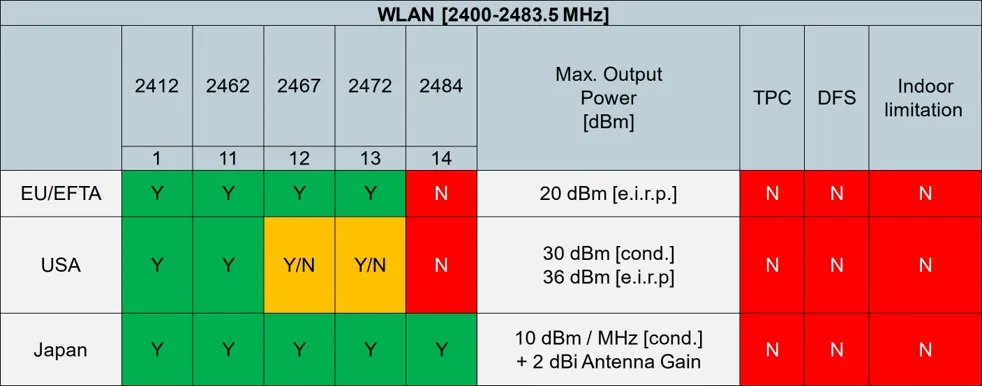
When it comes to radio product approval, technically speaking, the FCC and ISED have a lot in common. Unfortunately, there are also differences - and they are in the details. In some cases, the editions of the referenced test standards differ. There are also differences in the frequency ranges and output power values to be used.
Therefore, do not make the mistake of equating FCC and ISED. In addition to the differences in technical requirements mentioned above, there are also some differences in the type of approval. With Testlab as your partner, you have significant advantages: Due to the close cooperation between our accredited laboratory and the Notified Bodies, your radio approval for the markets EU, USA, Canada and Japan can be achieved from one source. For you, this means: less coordination and organization effort and the security of test reports from a service provider with an international reputation.
We would be happy to discuss this with you in a personal meeting.
But what about the tests that are supposed to fulfill the "Essential requirements according to RED (2014/53/EU)"?
"There's no difference", "You can test that together"... these are just two of the statements we often hear. Unfortunately, this is not correct.
If for the FCC and ISED "only" the frequency ranges and output power limits differ, the difference to the RED compliant test here is also the test setup. While, for example, the radio tests for FCC and ISED are performed at different table heights, the table height for RED-compliant tests is the same. Furthermore, the receiver is also tested during the radio tests for the European market, which is not taken into account during tests for FCC or ISED.
There are lots of other differences in testing and certification it is easy to get confused so please don’t hesitate to contact us.
What are InCountry exams and what should be considered?
Besides the many countries that accept either the test reports according to European standards or US-American standards, there are some countries (e.g. China, Brazil) where this is not sufficient for an approval. In some cases, these countries require their own standards. Testing in one of the laboratories of the respective country (InCountry) is also mandatory.
In order to be able to obtain approval in the respective countries, it is necessary to establish and maintain a network of contacts. Testlab has a team for this very purpose, which is called ITA (International Type Approval). This team coordinates all necessary tests and approvals for you in the respective countries, takes care of the communication with agents and authorities and ensures that all necessary documents are submitted on time.
How many test specimens/test samples are required?
In principle, only one test specimen is required for the tests of the radio technologies. However, it should be noted that several samples enable the laboratory to react quickly in case of failure of a DUT (which unfortunately does happen from time to time). Furthermore, tests can often be performed at the same time, which can significantly speed up the test plan. This reduces costs for you and ensures faster results.
Radio tests, especially according to RED, also require EMC and safety tests, for which several samples are needed in any case.
Recommendations from our side:
2 samples for the radio tests
2 samples for the EMC tests
2 samples for the safety tests
1 unsealed open sample for the documentation
What can I do as a manufacturer to ensure that the test passes successfully ? Is there a checklist ?
As a basis for the start of a smooth process, a lot of information is already useful for the preparation of the offer. The more information you have clarified at an early stage, the easier it is to carry out checks in order to avoid future errors.
The following information is already very helpful when preparing the quotation:
Model designation of the DUT (final, meaningful, unambiguous)
Data sheets of the DUT and radio modules used
Information about external cables, electrical ports and power supply
Temperature range
Maximum power consumption
Dimensions and weight of the DUT
Details on the radio technologies used
How can typical cost drivers/ errors be avoided?
Don't let yourself get carried away! Most errors are caused by time pressure, lack of information and poor preparation. Therefore, take your time and calmly do a few quality checks before the test date - it's worth it!
Preparation of the tests:
Good preparation of documents, equipment and especially commissioning are advisable
The test item should have the final status, since later changes would otherwise have to be addressed in the risk assessment and retests may be necessary
Tests on prototypes during development are also advisable
DUT designations and specifications must be consistent in all documents (data sheet, manual, etc.)
Commissioning of the setup in advance
Do all operating states and test modes work?
Check of the monitoring
Error simulation
Function of the monitoring software
Have the description of the test setups and the operation checked, e.g. by a colleague
Recommendation: Supply additional test items, e.g.
We hope that these tips will help you and already provide guidance for your next tests. Certainly not everything can be answered in detail here, so the following applies: talk to us, get advice and don't be afraid to ask questions. Our account managers have a lot of experience with the different requirements and technologies and will be happy to answer your questions by mail, phone or chat. We look forward to hearing from you!